UGC stands for user-generated content: photos, videos, reviews and posts about a brand that are made by real people instead of the brand itself. In marketing today it usually means one of two things: content customers post on their own, or short vertical videos a brand pays a creator to film so they look like ordinary posts. This guide covers both, the types that matter, and the part most guides skip: how to brief creators so the UGC you pay for brings in buyers, not just views.
What UGC means in 2026
The textbook definition is broad. Wikipedia defines user-generated content as content created by internet users, from images and video to testimonials. That covers everything from a five-star review to a forum post.
When a brand says "we need UGC," it almost always means something narrower: a 15 to 45 second vertical video where a real-looking person uses, shows or talks about the product. It gets posted on TikTok, Instagram Reels or YouTube Shorts, or run as an ad. The reason brands want it is simple. It looks like a post from someone in the feed, not like an ad.
Organic UGC vs paid UGC
These are two different things that share a name, and most confusion comes from mixing them up.
| Organic UGC | Paid (creator) UGC | |
|---|---|---|
| Who makes it | Customers and fans, unprompted | Creators you hire and brief |
| Cost | Free | Per video, or per package |
| Control | None: you get what you get | You choose the format, hook and CTA |
| Volume | Unpredictable | As many as you order |
| Rights | You need permission to reuse it | Usage rights are in the deal |
| Best use | Social proof, reviews, reposts | Ads, launches, testing angles |
Organic UGC is the strongest proof there is, but you can't schedule it. Paid UGC is what you can actually plan a campaign around, so the rest of this guide focuses on it.
The main types of UGC (and what each is for)
- Reviews and ratings: text and star ratings on your site, Amazon or Google. They help a visitor decide; they rarely bring new visitors.
- Customer photos and tags: posts where people show the product in their life. Good for reposts and product pages.
- Testimonial videos: a person on camera explaining why they bought. Strong on landing pages and in retargeting ads.
- Creator UGC videos: briefed short-form videos built around a specific format (demo, unboxing, before and after, packing orders, problem to fix). This is the type most brands mean, and the one they spend the most on.
- Creator posts run as ads: the creator posts the video on their own account and the brand puts paid spend behind it. On TikTok this is called Spark Ads. TikTok's help center describes it as a way to "publish ads using organic posts made by other creators (with their authorization)," with the views, comments and follows credited to the original post (TikTok Ads Help Center).
Why most paid UGC gets views but not sales
Here's the problem with how most brands buy UGC. They hire a creator, send over the product with a loose brief ("be authentic, show it off"), and get back a nice video. It gets views. The comments say "cute" and "love this." Nobody asks where to buy it.
Views and likes don't tell you whether a video sells. Comments asking to buy do: "link?", "where did you get this?", "how much?", "what's the app called?" Those are people trying to buy.
We looked at this in Postspace's own data. On November 2, 2026, the published, verified videos in Postspace's library carried 3,307 comments, each tagged by video format. 38 of them, about 1.1%, were buying-intent comments like the ones above. That rate was nowhere near even across formats:
| Format | Comments | Buying-intent comments | Rate |
|---|---|---|---|
| Packing Orders POV | 107 | 5 | 4.7% |
| Three Reasons, Fast Cuts | 194 | 7 | 3.6% |
| Unboxing First Reaction | 222 | 4 | 1.8% |
| Green-Screen Receipt | 199 | 3 | 1.5% |
| Text-First Silent Scroll | 278 | 3 | 1.1% |
| ASMR Process Shot | 1,640 | 15 | 0.9% |
| Before / After Split | 153 | 0 | 0% |
| Stitch The Wrong Take | 399 | 0 | 0% |
Treat these as directional, not a law: it's one sample, and some formats have only a few hundred comments. But the pattern is the point. The format with by far the most comments, ASMR, had one of the lowest buying rates, and stitch videos pulled hundreds of comments with no buying questions at all. Packing-orders and three-reasons videos, which show the product and what it does, got people asking how to buy.
So when you hire creators, the format you put in the brief matters more than how "authentic" the video feels.
How to brief creators for UGC that sells
A good UGC brief takes one page. It tells the creator exactly what to film and leaves room for them to make it sound like them.
1. Pick the format before you pick the creator
Choose the format based on what your buyer needs to see. If the product fixes an annoyance, use a problem-to-fix structure. If it's an app, show the screen in the first few seconds. If you sell volume on TikTok Shop, a packing-orders video shows demand. Our breakdown of the TikTok formats that sell products covers when each one works.
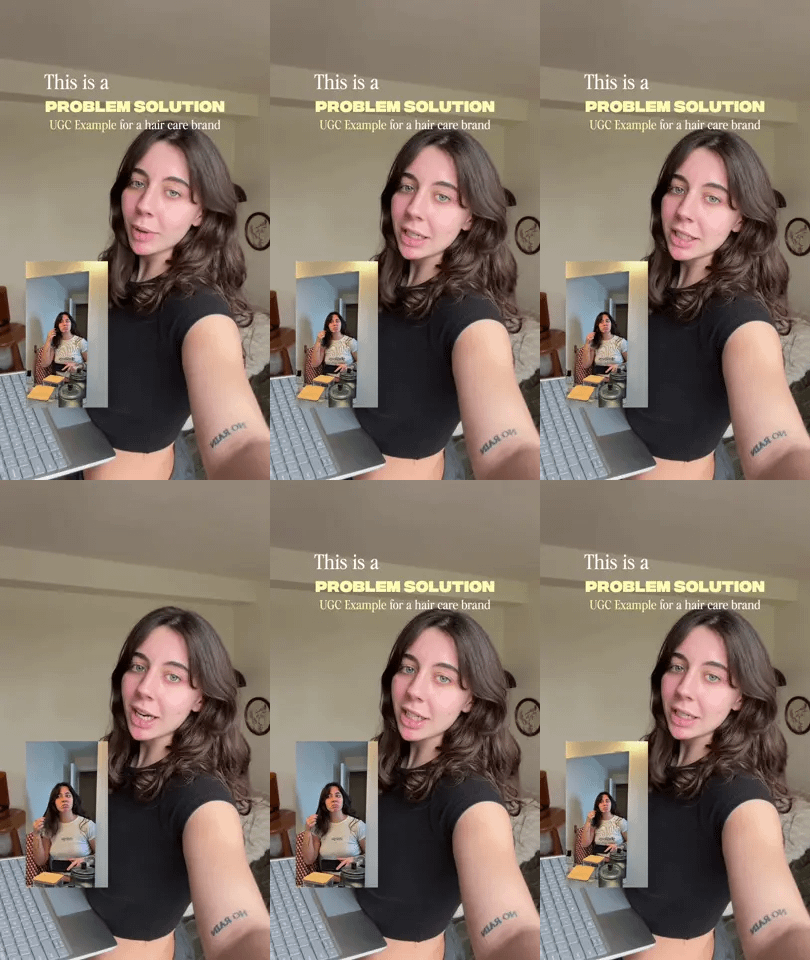
2. Write the hook for them
The first line decides who keeps watching. Give the creator two or three hook options written for your product, not a vague "grab attention." If you need a starting point, our hooks sorted by format pairs each opener with the video type it fits.
3. Give beats, not a script
List four to six beats with rough timestamps: what's on screen and what gets said. Creators who read scripts word for word sound like ads. Creators who hit beats in their own words sound like people.
4. Name the one thing buyers ask about
Every product has one question that stops a sale: price, sizing, "does it actually work," "is this a subscription." Put the answer in the video. Read your own comment sections first: our guide to reading TikTok comments to plan content shows how.
5. End with one plain CTA
One action, said casually: where to buy, or what the app is called. Not three.
6. Put disclosure in the brief
If you pay a creator or give them free product, the FTC expects the relationship to be disclosed. Its guidance says the disclosure "should be in the video and not just in the description," and that simple terms like "ad" or "sponsored" are often enough (FTC, Disclosures 101 for Social Media Influencers). Write it into the brief so nobody has to reshoot.
Worked example: a UGC brief for an under-sink organizer
Say you sell a $28 stacking organizer for the cabinet under the kitchen sink. The buyer's problem is a cabinet where nothing can be found. Here's the brief you'd send a creator:
Format: Problem → Agitate → Product
Hook (pick one):
- "If the cabinet under your sink looks like this, watch this."
- "I lost the dish soap in my own cabinet. Again."
Beats:
- 0:00 Open the cabinet, everything falls forward. No talking for the first second.
- 0:03 Say the hook out loud while digging for a sponge.
- 0:07 One more frustration: the bottles behind the pipe you can never reach.
- 0:11 Organizer goes in, one take, slide the drawer out.
- 0:18 Hold the finished cabinet still for three seconds so people can screenshot it.
On-screen text: "under-sink chaos → 10 minutes" at the start, the product name at the end.
Answer the buyer question: say whether it fits around the pipe, because that's what people ask.
CTA: "It's linked, it was $28." Then stop.
Disclosure: "ad" said or shown in the video, plus #ad in the caption.
That's the whole brief. A creator can film it in an afternoon, and every beat is there to get someone to the "where do I get this" comment.
How to tell if your UGC is working
Judge UGC by what buyers do, not by how many people watched:
- Buying-intent comments: count the "link?", "how much?" and "where do I get it?" comments per video. That number tells you more than likes do.
- Clicks and sales by video: give each creator or video its own link or code so you can see which one sold.
- Hook retention: if people drop off in the first two seconds, the hook is the problem, not the creator.
- Which format won: after 5 to 10 videos, compare formats. Order more of the winner and stop paying for the rest.
When you hire again, start from what worked. A brand that knows its best format and hook can brief ten creators in an hour.
If you work with several brands, the same process scales per client. See how agencies use Postspace, or browse every format in the library with its beats and hooks.